
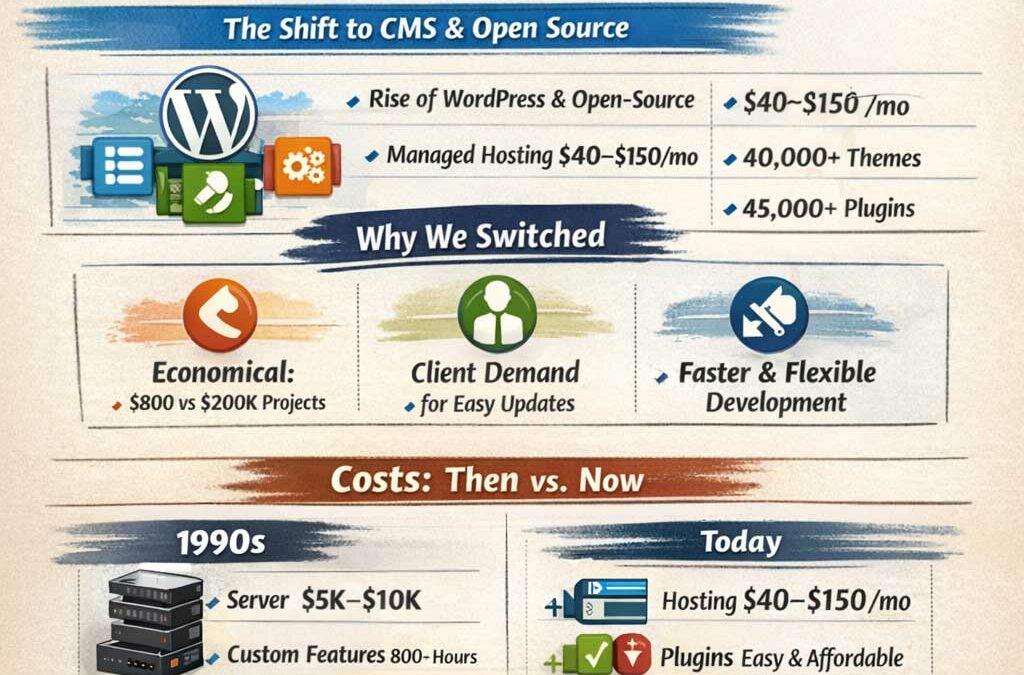
TL;DR: Custom website development went from requiring $5,000 to $10,000 in server licensing plus massive development costs ($3,000 to $200,000 for features like event management) to $40 to $150/month managed hosting with plugins at $800/year. We recognized the shift early and pivoted to WordPress and CMS platforms while others were still quoting custom development.
- 1990s custom development required expensive server licenses ($1,200 to $1,500 for ColdFusion alone), physical hardware management, and IT staff
- Custom features took 800+ development hours at $100 to $150/hour because everything was hand-coded from scratch
- WordPress powers 43.5% of websites today with 40,000+ free themes and 45,000+ plugins that replace months of custom coding
- Business-level managed hosting costs $40 to $150/month with no licensing fees versus old $5,000 to $10,000 upfront costs
- We recommend starting with existing plugins and CMS solutions… custom development only makes sense for genuinely unique requirements
Back in 1994, we ran our web server out of a back bedroom. A Macintosh server humming away, running WebStar and an email server called iMail.
If you wanted to build websites, you owned the hardware. You managed the infrastructure. You paid for every piece of software.
Today, WordPress powers 43.5% of all websites. PHP runs 79.2% of websites to some degree. The economics inverted completely.
We lived through this transformation. We saw the market shifting. We made the smart business decision to pivot before the economics left us behind.
What Server Licensing Cost in the 1990s
In 1995, we had two options for database-driven websites. ColdFusion by the Lari Brothers or Active Server Pages from Microsoft. Those were the only programming environments that tied to SQL databases and displayed dynamic content.
ColdFusion licenses ran $1,200 to $1,500 per server. Just the application server. Then you added Windows Server licensing on top… another $500 to $1,000 depending on your setup and client access licenses.
ASP came bundled with Windows Server and IIS. It looked “free” if you owned Windows Server. But you were locked into Microsoft’s ecosystem and all the licensing costs.
The pain hit when you scaled. Every additional server for load balancing or redundancy meant buying another complete set of licenses. Growing from one server to four servers multiplied those costs.
$5,000 to $10,000 in infrastructure licensing before writing a single line of code.
Compare that to business-level managed hosting running PHP and WordPress at $40 to $150 per month. We’re not talking about $10/month server farm hosting… that’s a shipwreck waiting to happen. The $40 to $150 range is proper business-level hosting. Simple sites sit at the lower end. E-commerce platforms needing more CPU power sit at the higher end.
What changed: Server licensing went from $5,000 to $10,000 upfront to $40 to $150/month because PHP and open-source eliminated proprietary barriers.
How We Managed Physical Servers in the 1990s
Day-to-day operations meant managing physical hardware. Servers sitting in your office or a data center. Machines needing cooling, backup systems, uninterruptible power supplies, and constant monitoring.
Something failed at 2am? Someone had to fix it. Professional IT support? You inherited those salary costs.
Web development transitioned almost entirely to Windows-based servers. Linux servers existed but were rare outside high-end graphics workstations like SGI machines. ColdFusion and ASP dominated because they were the only viable options for database-driven sites.
Everything sat in our lap:
- Server maintenance
- Software updates
- Security patches
- Backup management
- Disaster recovery planning
The IT overhead was insane compared to managed hosting today. That entire cost category disappeared for most businesses.
What we learned: Physical server management required dedicated IT staff and 24/7 monitoring… managed cloud hosting eliminated this operational burden.
Why PHP Eliminated the Licensing Model
PHP showed up around 1997-1998. We were skeptical. It felt like a scrappy open-source thing without corporate backing. We’d invested thousands into ColdFusion licenses and built expertise in that environment.
Switching to something free felt too good to be true.
The hesitation was real. We had clients depending on us. Projects in motion. A team trained on ColdFusion. Making the jump meant retraining, potentially rewriting code, and betting on technology without a sales rep or support contract.
But the economics became impossible to ignore.
We started experimenting with PHP on smaller projects. It did everything ColdFusion did without the licensing costs. It ran on Linux servers, which were also free. The math became clear.
The tipping point hit around 2000-2001. PHP matured rapidly. Community support exceeded what we were getting from expensive support contracts.
We transitioned our infrastructure. It changed our cost structure completely.
What we learned: PHP’s zero licensing cost plus Linux server compatibility destroyed the proprietary model… community support became better than paid contracts.
How WordPress Changed Client Expectations
By the early 2000s, something shifted in client conversations. People called saying “I’ve got a WordPress site. I need somebody to take it over.” Or they’d request a new website and when we’d mention ColdFusion, they’d respond “No, I want WordPress.”
This happened consistently over six months around 2006-2008. The market was moving to WordPress. The reason was simple… easier to use and cost less for features than hand-coding in ColdFusion or ASP.
The turning point came when three different clients in the same month requested WordPress by name. Before that, clients said “we need a website” and we’d recommend the technology. Suddenly clients were doing their own research and arriving with predetermined choices.
The moment of clarity hit when we quoted a client $15,000 to $20,000 for a custom ColdFusion site with a blog and news section. They came back and said “our friend launched a WordPress site for $3,000 and it does everything we need.”
We weren’t competing with other developers anymore. We were competing with an entire ecosystem of themes and plugins. A client could get a WordPress site with a pre-built theme, customize it, add plugins for contact forms, galleries, events… all for a fraction of our quote. They could manage and update it themselves.
We made the business decision to pivot. It wasn’t about whether WordPress was technically better. It was about market reality. Clients wanted WordPress. They could afford WordPress. If we didn’t offer it, they’d go elsewhere.
What this meant: Client requests for WordPress by name signaled the market had moved… custom development pricing couldn’t compete with the plugin ecosystem.
Why Custom Event Management Cost $200,000
Custom development costs were massive. We use event management as an example because it shows the economics clearly.
Developing a custom event management system in ColdFusion or ASP meant understanding every feature upfront. You didn’t want to get 30 days into development and have the client say “we wanted you to do this.” The back-and-forth destroyed timelines and budgets.
You’d map out everything:
- Multiple events with limited seating at multiple locations
- Automatic room overflow when one fills up
- Credit card processing
- Seating assignments
- Email confirmations
- Admin interfaces
Every feature added exponential complexity when hand-coding from scratch.
A fully-featured custom event system hit $200,000 in development costs. 800 to 1,000 hours of development, testing, and refinement.
Development Hours Drove the Cost
Every feature had to be hand-coded. Registration forms. Database structures to store events and attendees. Logic for seat limitations. Payment processing integration. Email confirmations. Admin interfaces. Nothing existed as a pre-built component.
Seat assignments alone consumed 40 to 60 hours at $100 to $150 per hour. You had to build the admin interface to create seating charts, store data structures, create user-facing selection interfaces, handle logic for filled seats, build error handling for double-bookings.
Payment processing was another massive undertaking. Integrating with payment gateways wasn’t like dropping in a Stripe plugin today. You wrote custom code to communicate with the payment processor’s API, handled security and encryption, managed transaction states, built error handling for failed payments. Another 30 to 50 hours.
Testing Time Equaled Development Time
When you write custom code, you test every scenario, every edge case, every failure point. If you spent 100 hours building features, you spent another 80 to 100 hours testing and fixing bugs.
Database work was more complex than people realize. You’re designing the entire data structure from scratch. How do you store multiple events? How do you relate attendees to events? How do you handle recurring events versus one-time events? Every decision has downstream implications.
Compare That to Event Espresso
Event Espresso is a WordPress plugin costing $800 per year. It has every feature you’d need for event management. All that development work, testing, and refinement has already been done and continuously improved by thousands of users.
WordPress being open source means third-party companies contribute plugins. Some are free, some are paid, some are freemium. You analyze which plugin matches your needs and install it.
The math: Custom event management system cost $200,000 and 1,000 hours versus an $800/year plugin… because hand-coding meant building every feature, testing every scenario, and designing database structures from scratch.
How One Change Doubled Project Costs to $100,000
We were working on a writer-developer project where people could write books and have them printed. Extremely complex, tying to printers, competing with Amazon at a smaller scale.
We got 30 days into coding. Past all the database schematics. Past feature and function approval. Then the client added one thing… it changed all the category relationships in the database.
We’d already coded all of that.
It wasn’t a complete rewrite but a restructuring of all the code. The project went from $40,000 to $50,000 in initial pricing to double that. $100,000 total.
When you change database structure mid-project after testing, you have to retest everything. Admin testing. User testing. Developer testing. Third-party integrations. We were tying into printers on location, working with print companies like 3M and Fuji. Massive amounts of testing.
Maintenance costs compound faster than development costs. One database relationship change rippled through the entire system. Every function that touched that data had to be reviewed, modified, and retested. The testing alone consumed weeks.
Changes locked down prior to starting development save massive time and money. But even with planning, custom development gets expensive fast. The complexity multiplies with every feature addition or modification.
Lesson learned: One mid-project database change doubled costs from $50,000 to $100,000 because maintenance and retesting compound faster than initial development.
What Questions to Ask Before Custom Development
When businesses come to us considering custom development over CMS solutions, we’re starting to see a pattern. They ask the wrong questions.
The issue is less about what the client asks and more about what the development team asks the client. The client needs a firm idea of how they want things to work before starting.
For a small database application like real estate listings, that’s fairly straightforward. Back in the 90s it was complex. Now it’s easy with WordPress. But depending on complexity, developers and clients not on the same page increases pricing dramatically.
Every project has an initial difficulty level. It doubles or triples in size if somebody changes something mid-stream. Getting all the answers upfront is vital. Most businesses don’t realize this until they’re committed to custom development and costs start escalating.
The emerging pattern we’re seeing… businesses ask “you build this custom feature?” when they should ask “does a plugin or CMS solution already exist that does this?”
The question itself reveals whether they understand the new economics or are still thinking in the old custom-development paradigm.
What we’re seeing: Businesses asking “build this custom?” instead of “does a plugin exist?” reveals they’re still thinking in the old expensive paradigm.
Our Recommendation When You Ask What Direction to Go
When clients ask “what direction should we go?”, we start with one question… what already exists that does what you need?
We saw the shift happening and adapted early. Now we help you navigate the same transition.
If you’re sitting across from us describing features you want built, our first move is mapping those features to the plugin ecosystem.
- Event management? Event Espresso costs $800/year versus $200,000 to build from scratch
- E-commerce? WooCommerce solved 90% of what you’re thinking you need custom-built
- Membership sites? Course platforms? Booking systems? The pattern holds across almost every use case
What Three Decades Taught Us
In the 90s and early 2000s, you paid $5,000 to $10,000 in server licensing before writing a single line of code. You needed physical hardware, IT staff, backup systems. Custom features like event management ran $3,000 to $200,000 depending on complexity. Testing time equaled development time. Maintenance costs compounded with every modification.
Today, we recommend business-level managed hosting running PHP and WordPress at $40 to $150 per month. Not the $10/month server farm hosting… that’s a shipwreck waiting to happen. Proper business-level hosting where the range depends on your site type. E-commerce sites require more CPU power and sit at the higher end. Simpler sites work perfectly at the lower range.
WordPress now powers 43.5% of all websites for a reason. Over 40,000 free themes and 45,000 free plugins exist. Features that used to require months of custom development now install in minutes.
When You Ask “Should We Build This Custom?”
Our answer is usually no. Not because we don’t have the skills… but because most projects don’t justify the exponentially higher costs of building from scratch.
We recognized this shift when clients started requesting WordPress by name and choosing $3,000 WordPress sites over our $15,000 to $20,000 custom quotes. We adapted our approach instead of fighting the market.
If you do have genuinely unique requirements that no plugin solves, here’s what we tell you upfront. Lock down every feature and function prior to starting development. We mean everything. One database relationship change mid-project doubles your costs. We’ve seen $50,000 projects become $100,000 projects because someone added “just one thing” after we started coding.
Maintenance and modification costs will likely exceed your initial development investment over time. That compounding effect is real.
For Most Projects
Our recommendation is clear. Start with the CMS ecosystem. Explore what plugins and themes already exist. Test whether existing solutions get you 80% to 90% of the way there.
The infrastructure revolution eliminated an entire category of costs. The open-source movement made sophisticated functionality accessible to everyone. The plugin ecosystem inverted the old economics completely.
That’s not opinion. That’s three decades of watching the market evolve, and it’s the foundation of how we approach every project now.
Our process: We map your features to existing plugins first… because custom development costs 10x to 250x more than using proven solutions that already exist.
Common Questions About Custom Development vs CMS Platforms
How much did server licensing cost in the 1990s compared to today?
In the 1990s, ColdFusion server licenses cost $1,200 to $1,500 per server, plus Windows Server licensing added another $500 to $1,000. Scaling to multiple servers meant multiplying those costs. Total infrastructure licensing ran $5,000 to $10,000 before writing any code. Today, business-level managed hosting for WordPress runs $40 to $150 per month with zero licensing fees.
Why did custom event management systems cost $200,000?
Custom systems required hand-coding every feature from scratch. Seat assignments alone took 40 to 60 hours at $100 to $150 per hour. Payment processing integration took another 30 to 50 hours. Testing time equaled or exceeded development time. A fully-featured system required 800 to 1,000 hours of development, testing, and refinement. Today, Event Espresso provides the same functionality for $800 per year.
What made PHP different from ColdFusion and ASP?
PHP was free and open-source, eliminating licensing costs entirely. It ran on Linux servers, which were also free, versus Windows-only servers requiring expensive licenses. Community support exceeded what expensive support contracts provided. The economics became impossible to ignore… same functionality without the licensing costs.
When did WordPress become the dominant platform?
Around 2006-2008, clients started requesting WordPress by name instead of letting us recommend the technology. The turning point came when clients could get WordPress sites for $3,000 that did everything a $15,000 to $20,000 custom ColdFusion site did. Today WordPress powers 43.5% of all websites with over 40,000 free themes and 45,000 free plugins.
Why do maintenance costs compound faster than development costs?
One database relationship change mid-project ripples through the entire system. Every function that touches that data needs review, modification, and retesting. We saw a $50,000 project double to $100,000 because the client added one thing that changed database category relationships 30 days into coding. The testing alone consumed weeks of additional work.
Should I avoid $10/month hosting for WordPress?
Yes. $10/month server farm hosting is a shipwreck waiting to happen. Business-level managed hosting at $40 to $150 per month provides proper infrastructure. The range depends on your site type. E-commerce sites require more CPU power and sit at the higher end. Simpler sites work perfectly at the lower range. Proper hosting prevents performance and security problems.
When does custom development make sense today?
Custom development makes sense when you have genuinely unique requirements that no plugin solves. But you need to lock down every feature and function prior to starting development. One mid-project change doubles your costs. For most projects, starting with the CMS ecosystem and testing whether existing solutions get you 80% to 90% of the way there saves massive time and money.
How do I know if a plugin exists for my needs?
Our first move is mapping your features to the plugin ecosystem. Event management? Event Espresso costs $800/year versus $200,000 custom. E-commerce? WooCommerce solved 90% of custom requirements. Membership sites, course platforms, booking systems… the pattern holds across almost every use case. Over 40,000 free themes and 45,000 free plugins exist in the WordPress ecosystem.
What makes WebWize different from other WordPress designers?
We’re the oldest and longest continually running web design firm in Texas with three decades of experience. But the real difference is our theme and plugin package. We include close to $1,000 worth of premium themes and plugins at no cost as long as you’re hosting with us. Most WordPress sites need premium themes ($60 to $200), form builders ($100 to $300), SEO tools, security plugins, backup solutions, and performance optimization. Those annual licensing fees add up to $460 to $1,350. We eliminate all of that. Plus we provide business-level managed hosting with monitoring, security hardening, and daily backups… not cheap shared hosting that leaves you stranded when problems hit.
Why Choose WebWize When WordPress Designers Are Everywhere
WordPress made web design accessible. You find one-off designers everywhere now.
So why go with WebWize?
Besides being the oldest and longest continually running web design firm in the state of Texas, we’ve built something unique. A theme and plugin package that’s second to none.
When you do business with us, we’ve eliminated almost all your license fees for themes and plugins. A new starter site company normally gets close to $1,000 worth of premium themes and plugins for absolutely no cost. Ever. As long as you’re hosting with us.
Here’s what that means in real numbers. Most WordPress sites need premium themes ($60 to $200), form builders ($100 to $300), SEO tools ($100 to $200), security plugins ($100 to $300), backup solutions ($50 to $150), and performance optimization ($50 to $200). That’s $460 to $1,350 in annual licensing fees before you add any specialized functionality.
We include all of that. No additional licensing fees. No renewals to track. No surprise costs when you need a new feature.
Three Decades of WordPress Expertise
We didn’t just jump on WordPress when it became popular. We saw the shift in 2006-2008 and made the business decision to master the platform. We’ve been building, optimizing, and supporting WordPress sites for over 15 years.
That experience shows in how we architect sites. Plugin compatibility issues? We’ve solved them. Performance bottlenecks? We’ve optimized thousands. Security vulnerabilities? We’ve hardened sites against every common attack vector.
One-off designers learn as they go. We’ve already been through the learning curve.
Business-Level Infrastructure Included
We mentioned the $40 to $150/month hosting earlier. That’s not just server space. That’s business-level managed hosting with monitoring, security hardening, automatic updates, daily backups, and performance tuning.
One-off designers usually point you to cheap shared hosting. Then when your site goes down or gets hacked, you’re on your own.
We’ve been managing servers since 1994. We know what proper infrastructure looks like because we’ve seen what happens when you cut corners.
The WebWize advantage: Three decades of experience, $1,000+ in premium themes and plugins included at no cost, and business-level infrastructure… because we recognized early that expertise plus eliminating ongoing licensing fees creates massive value.
Key Takeaways
- Server licensing costs dropped from $5,000 to $10,000 upfront in the 1990s to $40 to $150/month for business-level managed hosting today because PHP and open-source technology eliminated proprietary barriers
- Custom event management systems cost $200,000 and required 800 to 1,000 development hours versus $800/year for Event Espresso plugin… hand-coding every feature from scratch drove massive costs
- WordPress powers 43.5% of all websites with 40,000+ free themes and 45,000+ plugins because the ecosystem replaced months of custom development with minutes of plugin installation
- Maintenance costs compound faster than development costs… one mid-project database change doubled a $50,000 project to $100,000 because every function needed review, modification, and retesting
- Lock down every feature and function prior to starting custom development… changes mid-project double or triple costs because testing time equals or exceeds initial development time
- Start with the CMS ecosystem first and test whether existing solutions get you 80% to 90% of the way there… custom development costs 10x to 250x more than using proven plugins
- Avoid $10/month server farm hosting… business-level managed hosting at $40 to $150/month provides proper infrastructure where e-commerce sites need higher-end servers and simpler sites work at the lower range
When you’re ready to get started, contact the oldest and most experienced web design and development firm in the Great State of Texas. WebWize at 713-416-7111.

About Glenn Brooks
Glenn Brooks is the founder of WebWize, Inc. WebWize has provided web design, development, hosting, SEO and email services since 1994. Glenn graduated from SWTSU with a degree in Commercial Art and worked in the advertising, marketing, and printing industries for 18 years before starting WebWize.