
Why Google Reviews Are Being Deleted: Understanding AI Detection and Legal Takedowns in Houston
Quick Answer
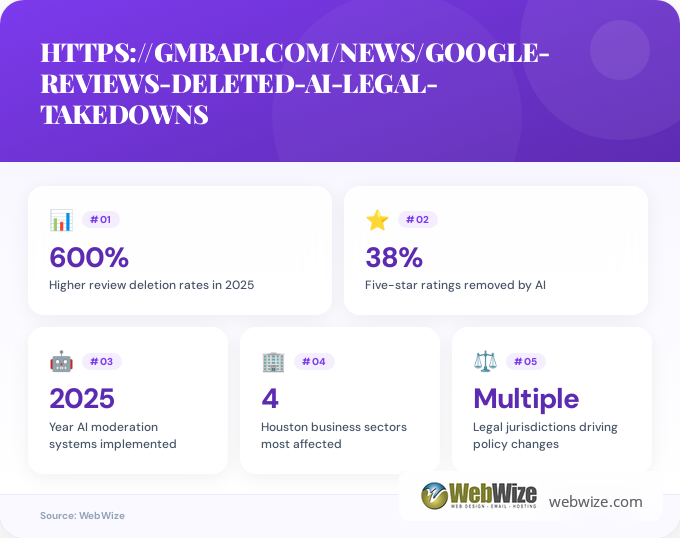
Google deleted reviews at 600% higher rates in 2025 using AI-driven moderation systems that removed 38% of five-star ratings, primarily targeting incentivized or unnatural-looking reviews rather than just negative content. Houston businesses face the same automated scrutiny as companies worldwide, with AI algorithms identifying suspicious patterns in reviewer behavior and content similarity.
Imagine waking up to discover that your business has lost dozens of hard-earned five-star reviews overnight. No warning. No explanation. This nightmare scenario became reality for thousands of businesses worldwide in 2025, and the trend continues to accelerate into 2026.
According to industry monitoring data, Google deleted reviews at 600% higher rates in 2025 compared to previous years. What’s most shocking is that 38% of deleted reviews were five-star ratings, defying the expectation that only negative reviews face removal.
For Houston businesses competing in the energy sector, medical services, hospitality, and retail markets, these deletions create significant challenges for local visibility and customer trust. Understanding why Google reviews are being deleted and how to navigate this new landscape has become critical for maintaining your digital reputation.
What Is Happening to Google Reviews in 2026?
The landscape of online reviews fundamentally shifted in 2025, and the implications continue to ripple through 2026. Google implemented aggressive AI-powered moderation systems that analyze every review submitted to its platform with unprecedented scrutiny.
Data from Search Engine Land revealed that review deletion rates accelerated dramatically between January and July 2025. Tens of thousands of monitored Google Business Profiles showed sharp increases in removals, with momentum building throughout the year.
This represents a fundamental change in how Google approaches review authenticity. Rather than relying primarily on user reports or manual review, automated systems now actively scan for patterns that suggest manipulation, coordination, or incentivization.
Why Is Google Deleting Reviews at Record Levels?
Google’s motivation for increasing review deletions stems from two interconnected goals: maintaining platform integrity and complying with evolving legal frameworks around online content.
The rise of sophisticated review manipulation services prompted Google to develop more advanced detection mechanisms. Businesses purchasing bulk reviews, incentivizing customers with discounts for positive feedback, or coordinating review campaigns triggered algorithmic red flags.
Additionally, legal pressures from multiple jurisdictions forced Google to implement more aggressive content moderation. Countries with strict defamation laws began holding platforms accountable for user-generated content, creating liability concerns that drove policy changes.
For businesses in Houston working with local SEO strategies, this shift requires fundamental changes in how you generate and manage customer reviews.

How Does AI Detection Target Reviews?
Google’s AI moderation systems analyze multiple data points to identify potentially fraudulent or policy-violating reviews. These algorithms have become increasingly sophisticated, examining factors that human moderators might miss.
The primary detection mechanisms include:
- Reviewer behavioral patterns: Accounts with minimal prior activity that suddenly post multiple reviews trigger suspicion
- Content similarity analysis: Reviews using similar phrases, sentence structures, or templates across multiple businesses indicate coordination
- Temporal clustering: Large numbers of reviews posted within short timeframes suggest orchestrated campaigns
- Geographic inconsistencies: Reviews from locations far from the business without travel indicators raise flags
- Response pattern matching: Business responses using templates or identical phrasing can mark reviews as suspicious
- Device and IP analysis: Multiple reviews from the same devices or network connections indicate potential manipulation
According to industry analysis, these AI systems operate continuously, scanning both new reviews and historical content. Reviews that passed moderation years ago may suddenly face deletion if new patterns emerge that connect them to suspicious activity.
| Detection Factor | What Triggers Removal | Impact Level |
|---|---|---|
| Account Activity | New accounts or those with no review history | High |
| Content Similarity | Template-based or repetitive language | Very High |
| Timing Patterns | Multiple reviews within hours or days | Medium |
Why Are Positive Reviews Being Removed?
The most counterintuitive finding from 2025’s deletion wave is that positive reviews face higher deletion rates than many businesses expected. While negative reviews certainly get removed for policy violations, the AI systems particularly target suspicious positive content.
Five-star reviews are removed when they exhibit characteristics suggesting:
- Incentivization: Language that hints at receiving discounts, freebies, or other benefits for leaving reviews
- Coordination: Multiple reviewers using similar positive phrases or focusing on identical business attributes
- Unnatural enthusiasm: Over-the-top praise that doesn’t match typical customer language patterns
- Generic content: Reviews lacking specific details about actual customer experiences
- Suspicious reviewer profiles: Accounts that only post five-star reviews or have unusual activity patterns
This creates a challenging situation for businesses that actively encourage customer reviews. Even legitimate, voluntary reviews from satisfied customers can trigger removal if they share characteristics with manipulated content.
Companies working with a search engine optimization company need to ensure their review generation strategies align with Google’s increasingly strict guidelines.
What Role Do Legal Takedowns Play?
While AI detection dominates the deletion landscape, legal takedowns represent a secondary but significant mechanism for review removal. This path has become particularly relevant in jurisdictions with strong defamation protections.
Legal takedown requests typically involve:
- Defamation claims: Reviews containing provably false statements that damage business reputation
- Privacy violations: Content revealing confidential customer or employee information
- Harassment allegations: Reviews deemed threatening or abusive beyond legitimate criticism
- Copyright infringement: Unauthorized use of trademarked terms or protected content
According to legal analysis, successful takedown requests require substantial documentation proving policy violations. Google doesn’t automatically remove content based on business complaints, instead requiring evidence that reviews violate specific terms of service or legal statutes.
Germany has emerged as a case study for legal-based deletions, with strict defamation laws creating a higher threshold for what constitutes acceptable criticism. However, these legal mechanisms represent a small fraction of total deletions compared to AI-driven removals.
How Are Houston Businesses Affected?
Houston businesses face the same algorithmic scrutiny as companies worldwide, but certain local factors create unique challenges. The city’s diverse economy, spanning energy, healthcare, hospitality, and professional services, means different sectors experience varying impacts.
Businesses in competitive Houston markets like the Medical Center, Downtown, or the Galleria area often implement aggressive review generation strategies to stand out. These campaigns now face higher risk of triggering AI detection systems.
Local service providers from Montrose to The Woodlands have reported sudden review losses without clear explanations. The lack of Houston-specific data from Google means businesses operate without understanding whether deletion rates differ from national averages.
Several factors make Houston businesses potentially vulnerable:
- High competition: Saturated markets encourage aggressive review solicitation
- Mobile workforce: Energy and construction businesses with traveling employees face geographic inconsistency flags
- Diverse customer base: International clients leaving reviews from overseas locations trigger suspicion
- Franchise operations: Multi-location businesses using standardized review requests appear coordinated
Working with digital marketing experts who understand these local dynamics helps Houston businesses navigate review management more effectively.
What Can Businesses Do to Protect Their Reviews?
Protecting your business from inappropriate review deletions requires understanding Google’s guidelines and implementing compliant review generation practices. The goal is encouraging genuine customer feedback while avoiding patterns that trigger AI detection.
Focus on organic review generation:
- Never incentivize reviews with discounts, freebies, or other compensation
- Avoid sending bulk review requests at the same time
- Don’t provide templates or suggested language to customers
- Let customers write reviews naturally without guidance on content
- Space out review requests over weeks rather than days
Educate your customer base:
- Encourage specific details about their actual experience
- Ask them to review from personal devices, not in-store tablets
- Suggest they include photos of products or services when relevant
- Remind them to use their established Google accounts rather than creating new ones
Manage your response strategy:
- Avoid template-based responses to reviews
- Personalize each response with specific details from the review
- Vary your language and tone across different responses
- Don’t respond immediately to every review (which appears automated)
Monitor your profile actively:
- Track review patterns and sudden changes in volume
- Document all legitimate reviews with customer interaction records
- Note any suspicious deletion patterns for potential appeals
- Maintain backups of review content and metadata
How to Recover Deleted Reviews?
When Google removes reviews, businesses have limited but important options for recovery. The process requires patience and documentation, with no guarantee of success.
Immediate steps after deletion:
- Document which reviews were removed and when
- Contact affected customers to verify the reviews were legitimate
- Check if customers received notifications about policy violations
- Review your recent review generation practices for potential triggers
- Examine whether deletions cluster around specific timeframes or review characteristics
Appeal process:
Google provides appeals mechanisms through the Google Business Profile support system. However, reputation management data shows appeals succeed in fewer than 30% of cases, particularly for AI-driven deletions.
To maximize appeal success:
- Provide evidence the review came from a legitimate customer
- Include transaction records, appointment confirmations, or other proof of service
- Demonstrate the reviewer has an established Google account history
- Explain any unusual circumstances that might have triggered false positives
- Be specific about why the deletion appears to be an error
When customers can help:
Legitimate reviewers can appeal deletions themselves, often with higher success rates than business appeals. If a customer received a notification about their review being removed, they can contest the decision through their Google account.
However, caution businesses against coordinating mass customer appeals, as this itself might appear as suspicious coordinated activity.
Prevention versus recovery:
The reality is that preventing deletions proves far more effective than recovering removed reviews. Once AI systems flag content as suspicious, reversing that determination becomes extremely difficult regardless of the review’s legitimacy.
People Also Ask
Can Google delete reviews without reason?
Google can remove reviews that violate its content policies or trigger AI detection systems, though they don’t always provide specific reasons. The automated moderation systems identify patterns suggesting manipulation, coordination, or policy violations, leading to deletions that may seem unexplained to business owners.
How long do deleted Google reviews stay removed?
Deleted reviews are permanently removed unless successfully appealed. The deletion is immediate and irreversible without going through Google’s appeal process, which has a low success rate. Even if customers resubmit identical reviews, these may also face deletion if the original removal was based on account or pattern issues.
Are negative reviews more likely to be deleted than positive ones?
Contrary to expectations, data from 2025 showed that 38% of deleted reviews were five-star ratings. AI detection systems target suspicious positive reviews more aggressively because they often indicate manipulation, incentivization, or coordination, while legitimate negative reviews typically exhibit natural customer frustration patterns.
What percentage of Google reviews get deleted?
Google deleted reviews at 600% higher rates in 2025 compared to previous years, though exact deletion percentages vary by industry and business. Monitoring data from tens of thousands of business profiles showed acceleration throughout 2025, with some businesses losing 20-50% of their review base during major algorithmic sweeps.
Can businesses prevent Google from deleting legitimate reviews?
Businesses cannot directly prevent deletions but can minimize risk by avoiding incentivized reviews, coordinated campaigns, and template-based solicitations. Focusing on organic review generation from verified customers with established Google accounts reduces the likelihood of triggering AI detection systems, though no method provides complete protection.
Does Google notify businesses when reviews are deleted?
Google typically does not notify businesses when reviews are removed. Business owners only discover deletions by monitoring their review counts and rating changes regularly, making proactive tracking essential for understanding when and why reviews disappear from their profiles.
Frequently Asked Questions
What triggers Google’s AI to delete reviews?+
Google’s AI systems flag reviews based on multiple factors including reviewer account history, content similarity across reviews, timing patterns, geographic inconsistencies, and response pattern matching. Reviews from new accounts, using template language, or posted in suspicious clusters face the highest deletion risk.
Is it illegal to ask customers for Google reviews?+
Asking customers for reviews is legal and acceptable, but offering incentives, discounts, or compensation in exchange violates Google’s policies. Businesses should request reviews naturally after positive service experiences without conditioning the request on positive ratings or providing templates for what customers should write.
How do I appeal a deleted Google review?+
Appeals can be submitted through Google Business Profile support with documentation proving the review came from a legitimate customer. Include transaction records, service confirmations, and explanation of any unusual circumstances. However, appeal success rates remain below 30%, particularly for AI-driven deletions rather than policy violation reports.
Why did Google delete my five-star reviews but keep negative ones?+
AI systems target suspicious positive reviews more aggressively because they often indicate manipulation attempts. Five-star reviews from new accounts, using similar language, or posted in clusters trigger deletion algorithms. Negative reviews typically show natural customer frustration patterns that appear more authentic to detection systems.
Can competitors report my reviews to get them deleted?+
Anyone can flag reviews as inappropriate, but Google’s systems verify flags before removing content. Legitimate reviews from real customers should survive competitor reporting unless they violate policies. However, if multiple users flag the same reviews, this may trigger additional AI scrutiny even for legitimate content.
What should Houston businesses do after losing multiple reviews?+
Document which reviews were removed, review your recent solicitation practices for policy violations, and adjust your review generation strategy to focus on organic feedback. Contact affected customers to verify legitimacy and consider appeals with supporting documentation, while implementing compliant practices going forward to prevent future deletions.
How long does it take for Google to restore wrongly deleted reviews?+
If appeals succeed, restoration typically occurs within 3-7 business days, though complex cases may take several weeks. Most deleted reviews remain permanently removed, as Google’s appeal process has a low approval rate and the company favors over-enforcement to maintain platform integrity rather than risking manipulation.
Key Takeaways
- Google deleted reviews at 600% higher rates in 2025 using AI-driven moderation systems, with 38% of removals affecting five-star ratings rather than negative content.
- AI detection systems analyze multiple factors including reviewer account history, content similarity, timing patterns, and geographic consistency to identify suspicious reviews.
- Positive reviews face higher scrutiny because they often indicate manipulation attempts through incentivization, coordination, or template-based solicitation.
- Houston businesses experience the same algorithmic enforcement as companies worldwide, with local competitive pressures potentially increasing vulnerability to deletion triggers.
- Prevention proves far more effective than recovery, as appeal success rates remain below 30% and focus should shift to compliant, organic review generation practices.
- Legal takedowns represent a secondary mechanism for review removal, requiring substantial documentation of policy violations or legal statute breaches.
- Businesses must adapt review strategies to avoid incentivization, coordination signals, and template-based approaches that trigger AI detection systems.
Navigating the New Review Landscape
The dramatic increase in Google review deletions throughout 2025 and continuing into 2026 represents a fundamental shift in how businesses must approach online reputation management. The days of aggressive review solicitation campaigns and incentivized feedback are definitively over.
For Houston businesses competing in markets from the Energy Corridor to Rice Village, the path forward requires patience and authenticity. Building genuine customer relationships that naturally generate reviews takes more time than bulk solicitation campaigns, but creates sustainable, algorithm-resistant review profiles.
The 600% increase in deletion rates serves as a clear signal that Google prioritizes platform integrity over business convenience. While this creates short-term challenges for companies that relied on aggressive review generation, it ultimately benefits businesses that invested in authentic customer experiences and organic feedback.
Success in this new landscape requires understanding the AI detection mechanisms, implementing compliant review practices, and maintaining vigilant monitoring of your review profile. The businesses that thrive will be those that view reviews as a reflection of genuine customer satisfaction rather than a metric to be manipulated.
If your Houston business needs help navigating these changes and implementing sustainable review management strategies that comply with Google’s evolving standards, professional guidance can make the difference between maintaining your hard-earned reputation and losing it to algorithmic deletions.