
Web Design for Small Business: The Complete Guide to Building a Powerful Online Presence in 2026
Quick Answer
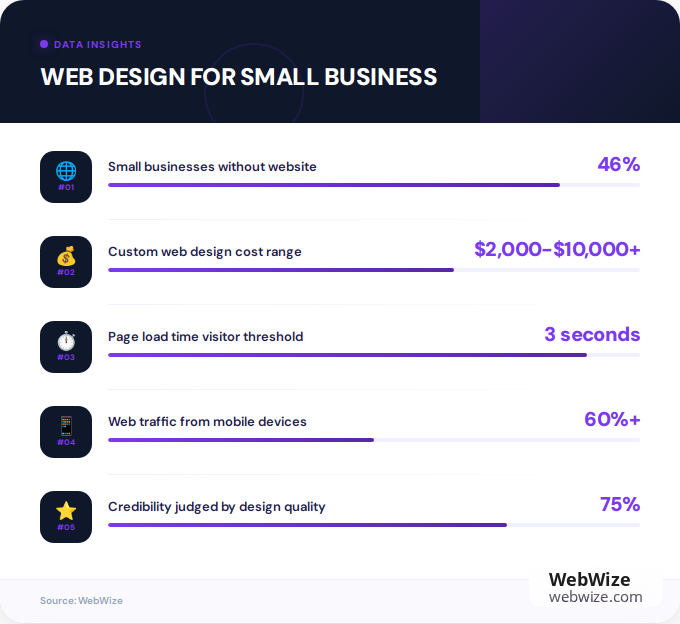
Web design for small business is the process of creating professional, conversion-focused websites tailored to local companies' needs, typically costing between $2,000 to $10,000+ for custom design with annual maintenance around $1,200, though pricing varies based on your specific project requirements and business goals. With 46% of small businesses still lacking a website despite 87% of owners planning to build one, effective web design has become essential for credibility, customer acquisition, and competitive positioning in 2026.
Here's a startling reality: despite living in an increasingly digital world, 46% of small businesses still operate without a website. Even more surprising, 94% of first impressions about your business stem from your website design, and 75% of your credibility is judged based on how your site looks. In the $40+ billion global web design services market, small businesses face a critical decision that could determine their survival or success.
As we navigate 2026, the gap between businesses with strategic, conversion-focused websites and those with outdated or nonexistent online presences continues to widen. With 60%+ of all web traffic now coming from mobile devices and 53% of visitors abandoning sites that take more than three seconds to load, web design for small business has evolved from a nice-to-have luxury into an absolute necessity.
What Is Web Design for Small Business?
Web design for small business encompasses the strategic planning, visual design, and technical development of websites specifically tailored to local companies, service providers, and entrepreneurs. Unlike generic template websites, effective small business web design focuses on converting visitors into customers through clear messaging, intuitive navigation, and trust-building elements.
The global web design services market has exceeded $40 billion, with the U.S. market alone reaching $43.5 billion in 2024 and growing at a 2.2% CAGR. This growth reflects businesses' increasing recognition that their website serves as their most important sales and marketing asset.
Modern small business web design incorporates several critical components: responsive layouts that adapt to any device, search engine optimization for local visibility, accessibility features for all users, and conversion-focused architecture that guides visitors toward specific actions. According to industry statistics, 90% of websites now use responsive design, making mobile compatibility the standard rather than the exception.
Why Does Web Design Matter for Small Businesses?
The impact of web design on small business success extends far beyond aesthetics. Research shows that 38% of visitors will stop engaging with a website if the content or layout is unattractive, while investments in user experience can boost conversions by up to 400%.
First impressions form instantly. When potential customers discover your business online, they make snap judgments about your professionalism, trustworthiness, and quality based purely on visual presentation. 75% of credibility assessments stem directly from website design quality, meaning poor design literally costs you customers before they even read your content.
The business case is compelling when examining traffic data. According to small business website statistics, 46% of U.S. small business sites receive between 1,001 and 15,000 monthly visitors, while 65.3% see under 50,000 visits. Each of these visitors represents a potential customer, and design quality directly influences whether they stay, engage, and convert.

How Much Does Web Design for Small Business Cost?
Understanding web design pricing requires recognizing that costs vary dramatically based on your specific project scope, functionality requirements, design complexity, and long-term goals. Investment ranges typically span from a few hundred dollars for basic DIY solutions to $10,000, $25,000, or even $50,000+ for comprehensive custom development.
For small businesses seeking professional design, pricing typically falls between $2,000 to $10,000 for initial development, with annual maintenance costs around $1,200. Corporate websites with advanced features generally require investments of $10,000 to $35,000+ for design, plus approximately $15,000 in annual maintenance and updates.
| Approach | Initial Investment | Annual Maintenance |
|---|---|---|
| DIY Website Builder | $200 to $1,500 | $300 to $600 |
| Professional Small Business Design | $2,000 to $10,000+ | $1,200+ |
| Corporate/Advanced Site | $10,000 to $50,000+ | $15,000+ |
These ranges reflect the reality that every business has unique needs. A local service provider might need a simple five-page site with contact forms and service descriptions, while an e-commerce business requires payment processing, inventory management, and complex customer account functionality. Premium design emphasizes craftsmanship, strategic thinking, and long-term value rather than simply being the lowest-cost option.
The employment landscape reflects this market's value. Around 200,000 web designers work in the U.S., earning a median wage of $98,090, with employment projected to grow 7% from 2024 to 2034. This professional expertise commands appropriate compensation because effective web design requires technical skill, strategic thinking, and business acumen.
What Are the Essential Elements of Effective Small Business Web Design?
Successful web design for small business incorporates specific elements that drive results. These components work together to create websites that attract visitors, build trust, and convert browsers into customers.
Speed and Performance: With 53% of visitors abandoning sites that take longer than three seconds to load, performance is non-negotiable. Fast-loading sites rank better in search engines, provide better user experiences, and convert at higher rates. Responsive images load 25% faster on mobile devices, directly impacting bounce rates and engagement.
Mobile Responsiveness: Given that 60%+ of web traffic originates from mobile devices, mobile-first design has become essential. 85% of users expect mobile sites to match or exceed desktop experiences. Businesses implementing mobile-first design see 20% higher engagement rates compared to desktop-only approaches.
Clear Value Proposition: Visitors should understand what you offer and why they should choose you within seconds of landing on your site. According to web design research, clarity directly correlates with conversion rates. Your homepage must immediately communicate who you serve, what problems you solve, and what makes you different.
Trust Signals: Small businesses must overcome the credibility gap that larger competitors enjoy. Effective trust-building elements include customer testimonials, case studies, professional photography, security badges, clear contact information, and transparent pricing. These elements work together to demonstrate legitimacy and build confidence.
Conversion-Focused Architecture: Every page should guide visitors toward specific actions, whether booking consultations, requesting quotes, making purchases, or contacting your team. Strategic placement of calls-to-action, simplified forms, and friction-reducing design choices all contribute to higher conversion rates.
What Web Design Trends Are Shaping Small Businesses in 2026?
The web design landscape continues evolving rapidly, with 2026 trends emphasizing personalization, artificial intelligence integration, and optimization for AI search engines like ChatGPT, Perplexity, and Gemini.
AI Integration: Over 50% of web designers now use AI tools for imagery and content creation, while 65% of businesses have adopted AI design tools. More than 50% of new websites integrate chatbots for customer service. These tools provide 24/7 support, answer common questions instantly, and qualify leads before human interaction.
Voice Search Optimization: With voice search projected to influence 30% of website traffic in 2026, small businesses must optimize for conversational queries and natural language patterns. This means incorporating FAQ sections, conversational content, and structured data that voice assistants can easily parse and present.
Augmented Reality (AR): AR technology is expected to drive $6 billion in e-commerce sales in 2026. Small businesses in retail, real estate, home services, and similar industries increasingly use AR to let customers visualize products in their spaces before purchasing.
Benefit: Higher engagement and conversion
Adoption: Growing rapidly in 2026
Benefit: Broader audience reach
Requirement: Increasingly legally mandated
Impact: Search ranking factor
Result: Better user experience
Format: FAQs, tables, clear answers
Goal: Featured in AI responses
Sustainability and Minimalism: Eco-conscious design reduces server loads, improves performance, and appeals to environmentally aware consumers. Clean, minimalist layouts also load faster and provide better user experiences, creating a win-win scenario.
Should Small Businesses Use DIY Website Builders or Hire Professionals?
The choice between DIY platforms and professional web design services depends on your budget, technical skills, time availability, and business goals. Website builders like Wix, which holds approximately 45% market share with over 8 million sites, offer accessible entry points for businesses with limited budgets.
DIY website builders provide several advantages: lower initial costs, quick setup, template-based design requiring no coding knowledge, and all-in-one hosting solutions. They work well for businesses needing simple online presences quickly or testing concepts before major investments.
However, professional web design offers distinct benefits that DIY solutions cannot match. Custom design creates unique brand identities rather than template-based appearances shared with thousands of other businesses. Professional developers build optimized code for better performance, implement advanced functionality, provide strategic guidance on conversion optimization, and deliver ongoing maintenance and support.
The employment data tells an important story: with 14,500 annual job openings for web designers and Figma appearing in 67% of job listings, professional web design remains a thriving industry despite DIY tools. This persistence exists because businesses recognize the value that expertise provides.
Web design agencies report profit margins of 15% to 25% through maintenance contracts and ongoing optimization services. This recurring revenue model reflects the reality that websites require continuous improvement rather than one-time builds. The average website lifespan is 2 to 3 years before requiring significant updates or redesigns.
How Does Mobile-First Design Impact Small Business Success?
Mobile-first design has transitioned from optional strategy to fundamental requirement. With 70% of e-commerce sales projected to come from mobile devices in 2026, businesses ignoring mobile optimization forfeit the majority of potential customers.
According to conversion optimization research, mobile-first approaches yield 20% higher engagement compared to desktop-first designs adapted for mobile. This performance difference stems from intentional design choices that prioritize the constraints and opportunities of smaller screens.
Mobile-first design principles include touch-friendly interface elements with adequate tap targets, simplified navigation reducing cognitive load, faster load times through optimized assets, and vertical scrolling patterns matching natural mobile behavior. These considerations create experiences tailored to how people actually use mobile devices rather than simply shrinking desktop layouts.
The business impact extends beyond user experience to search visibility. Google's mobile-first indexing means the search engine primarily uses the mobile version of your site for ranking and indexing. Businesses with poor mobile experiences see reduced search visibility regardless of desktop quality.
Voice search further amplifies mobile importance, as most voice queries originate from smartphones. With 30% of traffic influenced by voice search in 2026, mobile-optimized sites with conversational content and structured data capture more of this growing channel.
Key Takeaways
- 46% of small businesses still lack websites, creating significant opportunities for those who invest in professional web design to differentiate themselves and capture market share.
- 94% of first impressions and 75% of credibility judgments stem from website design, making it your most important marketing asset regardless of industry or business size.
- Professional web design investments range from $2,000 to $50,000+ depending on scope and complexity, with pricing based on your specific project requirements, functionality needs, and long-term business goals.
- Mobile traffic comprises 60%+ of web visits, and mobile-first design yields 20% higher engagement, making responsive design absolutely essential rather than optional.
- 53% of visitors abandon sites loading over three seconds, emphasizing that performance optimization directly impacts revenue and customer acquisition.
- AI tools are now used by over 50% of designers, and 65% of businesses have adopted AI design tools, representing a fundamental shift in how websites are created and maintained.
- The average website lifespan is 2 to 3 years, requiring $1,200 to $15,000+ in annual maintenance, positioning websites as ongoing investments rather than one-time projects.
People Also Ask
Small business website costs typically range from $2,000 to $10,000 for professional design, with annual maintenance around $1,200. DIY website builders can reduce costs significantly to a few hundred dollars annually, though professional design provides superior customization, optimization, and strategic value that justifies the higher investment.
Approximately 46% to 54% of small businesses still lack websites, though 87% of small business owners plan to create one. This gap represents both a competitive disadvantage for businesses without online presences and a significant opportunity for those who invest in professional web design to stand out in their markets.
38% of visitors stop engaging with websites due to poor design or unattractive layouts, while 53% abandon sites that take longer than three seconds to load. Other common reasons include confusing navigation, unclear value propositions, lack of mobile optimization, and missing trust signals like testimonials or security indicators.
The average website lifespan is 2 to 3 years before requiring significant updates or complete redesigns. This timeline reflects evolving design trends, changing user expectations, technology updates, and business growth requiring expanded functionality. Ongoing maintenance and incremental improvements can extend this lifespan while keeping sites current and competitive.
Wix holds approximately 45% market share with over 8 million sites, making it the most popular DIY option. However, "best" depends on your specific needs, with Squarespace excelling for visual businesses, Shopify leading e-commerce, and WordPress offering maximum flexibility for those with technical skills or working with professional developers.
Web design directly impacts SEO through site speed (load times under 3 seconds), mobile responsiveness (60%+ of traffic), content structure, internal linking architecture, and user experience metrics that search engines track. Poor design increases bounce rates and reduces time on site, sending negative signals that lower search rankings regardless of content quality.
Frequently Asked Questions
Yes, modern website builders like Wix, Squarespace, and Shopify allow you to create functional websites without any coding knowledge through drag-and-drop interfaces and pre-designed templates. However, DIY sites typically offer less customization, potentially slower performance, and may lack the strategic optimization that professional designers provide for conversion and search visibility.
Most websites require significant updates or complete redesigns every 2 to 3 years to stay current with design trends, technology standards, and user expectations. Between major redesigns, plan for minor content updates monthly, security patches regularly, and performance optimizations quarterly to maintain effectiveness and protect against security vulnerabilities.
Essential pages include a homepage with clear value proposition, services or products page detailing offerings, about page building trust and credibility, contact page with multiple connection options, and testimonials or case studies demonstrating results. Depending on your business, you may also need blog, FAQ, pricing, and location pages to serve customer needs and improve search visibility.
Website speed is critically important, with 53% of visitors abandoning sites that take longer than three seconds to load. Fast sites not only retain more visitors but also rank higher in search results, convert better, and provide superior user experiences. Speed optimization should be a top priority regardless of your business size or industry.
Mobile-first design means creating websites primarily for mobile devices, then adapting them for larger screens, rather than the reverse. This approach matters because 60%+ of web traffic comes from mobile devices, and mobile-first sites achieve 20% higher engagement while also benefiting from Google's mobile-first indexing for better search rankings.
E-commerce functionality makes sense if you sell physical or digital products directly to customers, especially considering 70% of e-commerce sales are projected to come from mobile devices in 2026. However, service-based businesses may benefit more from booking systems, quote request forms, or consultation schedulers rather than full shopping carts, depending on their specific business model.
Track key metrics including conversion rate (percentage of visitors taking desired actions), bounce rate (visitors leaving after viewing one page), average session duration, pages per session, and traffic sources. Use tools like Google Analytics to monitor these metrics monthly, setting specific goals such as form submissions, phone calls, or purchases to measure ROI on your web design investment.