
Search Engine Optimization for Website in Houston: Your Complete 2026 Guide
Quick Answer
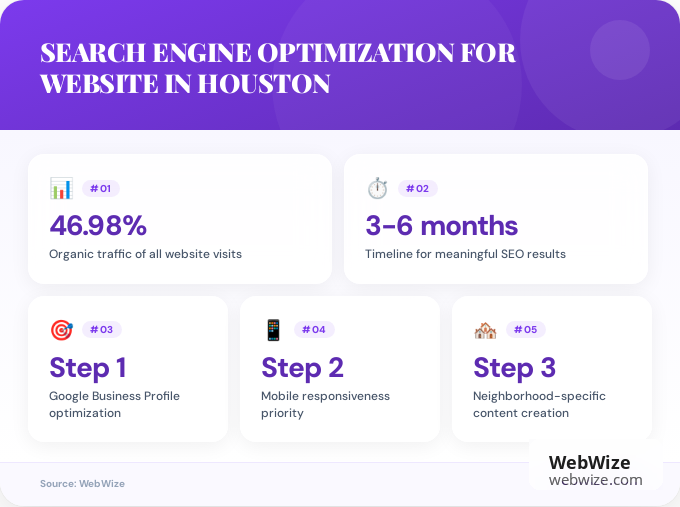
Search engine optimization for websites in Houston requires a hyperlocal approach emphasizing Google Business Profile optimization, neighborhood-specific content, and technical performance, with organic traffic representing 46.98% of all website visits in 2026. Houston businesses typically see meaningful SEO results within 3 to 6 months when implementing consistent strategies that prioritize search intent matching, mobile responsiveness, and local authority building across Houston’s competitive market.
Did you know that organic search drives 46.98% of all website traffic in 2026, yet most Houston businesses still struggle to capture their fair share? In a metropolitan area where competition rivals national spending levels, mastering search engine optimization for your website in Houston isn’t just an advantage anymore. It’s survival.
The Houston market presents unique challenges that generic SEO strategies simply can’t address. From the sprawling neighborhoods of Cypress to the bustling Energy Corridor, from the Heights to Sugar Land, your potential customers are searching for solutions right now. The question is: will they find your business or your competitor’s?
This comprehensive guide reveals the exact strategies Houston businesses use to dominate local search results, convert organic traffic into revenue, and build sustainable online visibility that withstands algorithm updates and competitive pressure.
What Is Search Engine Optimization for Houston Websites?
Search engine optimization for websites in Houston is the strategic process of improving your website’s visibility in organic search results for queries relevant to your business, products, or services. Unlike paid advertising, SEO focuses on earning rankings through quality content, technical excellence, and authoritative signals that search engines trust.
For Houston businesses specifically, SEO extends beyond traditional tactics to include hyperlocal optimization strategies that target neighborhood-level searches. When someone searches for "HVAC repair in Memorial" or "divorce attorney near Katy," your SEO strategy determines whether your business appears in those critical moments of intent.
The fundamentals remain consistent: keyword research, on-page optimization, technical infrastructure, content creation, and link building. However, Houston’s competitive landscape demands a more sophisticated approach that integrates modern SEO strategies specifically designed for 2026.
The Components of Effective Houston SEO
A complete search engine optimization strategy for Houston websites includes several interconnected elements working together:
- Local SEO optimization: Google Business Profile management, local citations, location-specific content
- Technical SEO: Site speed, mobile responsiveness, Core Web Vitals, structured data
- On-page SEO: Title tags, meta descriptions, header optimization, internal linking
- Content marketing: Blog posts, service pages, neighborhood guides targeting search intent
- Link building: Earning backlinks from authoritative Houston websites and industry publications
- Conversion optimization: Turning organic traffic into leads and customers
The right web strategy integrates these elements into a cohesive system rather than treating them as isolated tactics.
Why Is Houston’s SEO Landscape Different in 2026?
Houston’s SEO environment presents distinct challenges that set it apart from other markets. The city’s geographic sprawl, diverse economy, and competitive business climate create unique optimization requirements that demand specialized knowledge.
Research shows that "near me" searches yield only 23% website overlap across different cities in AI-powered search results. However, when searchers add "Houston" to their query, result consistency jumps to 50-55%. This data point reveals a critical insight: Houston-specific optimization isn’t optional; it’s essential for visibility.
"The Houston market now requires the same level of SEO sophistication as national campaigns. Businesses that approach local search with generic strategies are leaving significant opportunities on the table. In 2026, hyperlocal content targeting specific neighborhoods outperforms broad city-wide approaches by substantial margins." — Fair Marketing SEO Strategy Report
The Houston Market Reality
Houston’s business environment creates several specific SEO considerations:
Geographic complexity: With over 2.3 million residents spread across 670 square miles and surrounding suburbs like Pearland, Spring, and League City, a single "Houston" strategy misses the granularity modern search algorithms reward. Each neighborhood represents distinct search patterns and competitive dynamics.
Industry diversity: From energy sector headquarters to medical center specializations, from restaurants in Montrose to retail in the Galleria area, Houston’s economic variety demands industry-specific SEO approaches tailored to different buyer journeys and search behaviors.
Mobile-first searching: Houston’s car-dependent culture means 76% of voice searches have local intent, with mobile devices serving as the primary search tool for commuters, visitors, and residents navigating the city’s vast geography.

How Does Local SEO Work for Houston Businesses?
Local SEO represents the most critical component of search engine optimization for websites in Houston. While traditional SEO focuses on organic rankings, local SEO specifically targets map-based results, local pack placements, and geographically qualified searches.
The data supporting local SEO investment is compelling: 96% of consumers write reviews, and businesses with complete Google Business Profiles experience 70% more visits than incomplete profiles. The average optimized GBP listing generates 81 monthly actions, broken down as 38% directions requests, 35% website visits, and 27% phone calls.
Google Business Profile Optimization
Your Google Business Profile serves as the foundation of local search visibility. Comprehensive optimization includes:
- Complete business information: Accurate NAP (Name, Address, Phone), hours, categories, attributes
- Regular posts and updates: Weekly content demonstrating active engagement
- Photo optimization: High-quality images of your location, team, products, and services
- Review management: Systematic process for earning and responding to reviews
- Q&A monitoring: Proactive answers to common questions
Houston businesses must also optimize for specific neighborhoods. Instead of only listing "Houston, TX," create location pages for areas you serve: Medical Center, Midtown, River Oaks, Cypress, Katy, Pearland, and others relevant to your service area.
Local Citation Building
Citations are mentions of your business name, address, and phone number across the web. Consistency across directories, industry platforms, and local websites signals legitimacy to search engines.
| Citation Type | Examples | SEO Impact |
|---|---|---|
| General Directories | Yelp, YellowPages, BBB | Foundational trust signals |
| Industry-Specific | Avvo (legal), Healthgrades (medical) | Niche authority building |
| Local Houston Sites | Houston Chronicle, local chambers | Geographic relevance boost |
Citation accuracy matters more than volume. A single incorrect phone number across multiple platforms can undermine trust signals and confuse potential customers.
Location-Specific Content
Creating dedicated pages for each Houston neighborhood or suburb you serve provides search engines with clear geographic signals while delivering relevant content to local searchers. These pages should include:
- Neighborhood-specific service information
- Local landmarks and directional guidance
- Community insights demonstrating local knowledge
- Testimonials from customers in that area
- Unique content (not duplicated templates)
For example, an HVAC company might create separate optimization strategies for "AC repair in Cypress" versus "air conditioning service in Sugar Land," recognizing different competitive landscapes and customer demographics.
What Technical SEO Elements Matter Most?
Technical SEO creates the foundation that allows your content and local signals to perform effectively. Search engines prioritize websites that deliver fast, secure, accessible experiences across all devices.
Current SEO statistics show that Core Web Vitals now directly impact rankings, with page speed, mobile usability, and visual stability serving as measurable ranking factors. Houston businesses competing for visibility cannot ignore these technical fundamentals.
Core Web Vitals Optimization
Google’s Core Web Vitals measure real-world user experience through three specific metrics:
- Largest Contentful Paint (LCP): Loading performance (should occur within 2.5 seconds)
- First Input Delay (FID): Interactivity (should be less than 100 milliseconds)
- Cumulative Layout Shift (CLS): Visual stability (should maintain a score below 0.1)
Improving these metrics requires technical interventions: image optimization, code minification, server response time improvements, and strategic resource loading. Houston businesses with slow-loading websites lose potential customers before content even renders.
Mobile Responsiveness
With mobile devices driving the majority of local searches, responsive design isn’t optional. Your website must deliver full functionality and optimal experience on smartphones and tablets.
Google uses mobile-first indexing, meaning the mobile version of your site determines rankings even for desktop searches. Test your site thoroughly across devices, ensuring buttons are tappable, text is readable without zooming, and navigation works intuitively on smaller screens.
Technical Audit Priorities
Regular technical audits identify issues that undermine search performance:
- Broken links: Internal and external links that return errors
- Duplicate content: Identical content across multiple URLs
- Missing schema markup: Structured data that helps search engines understand content
- XML sitemap issues: Incomplete or outdated sitemap submissions
- Security concerns: HTTPS implementation, security headers
- Crawl errors: Pages blocked from search engine access
These technical elements work invisibly but powerfully, either enabling or preventing your content from achieving its ranking potential.
How Should Houston Businesses Approach Content Strategy?
Content strategy for search engine optimization in Houston must balance search engine requirements with genuine value delivery. The era of keyword-stuffed articles has ended; Google’s helpful content updates now prioritize search intent matching over keyword density.
Research demonstrates that pages matching user intent achieve 32% higher engagement compared to keyword-optimized pages that miss intent. This shift requires understanding what searchers actually want when they enter specific queries.
Search Intent Categories
Every search query falls into one of four intent categories, each requiring different content approaches:
Content: Educational guides, how-to articles
Example: "What is local SEO"
Content: Brand pages, contact information
Example: "WebWize Houston"
Content: Comparison guides, reviews
Example: "Best SEO company Houston"
Content: Service pages, contact forms
Example: "Hire SEO consultant Houston"
Your content strategy should address all four categories, creating pathways that guide searchers from initial research through to conversion.
Content Types That Perform
For Houston businesses, several content formats consistently deliver SEO value:
Neighborhood guides: Comprehensive resources about specific Houston areas you serve, including local insights, service availability, and community information. These demonstrate local expertise while capturing long-tail searches.
Service-focused blog posts: Educational content that answers common questions related to your services. A Houston plumber might create "How to prevent frozen pipes during rare Houston freezes" rather than generic plumbing advice.
Case studies and testimonials: Real customer stories from Houston clients, featuring specific neighborhoods, challenges, and outcomes. These build trust while incorporating geographic keywords naturally.
FAQ pages: Structured answers to common questions, formatted for featured snippet capture and voice search optimization.
Quality matters infinitely more than quantity. A single comprehensive, authoritative article targeting search intent outperforms dozens of thin, generic posts.
What Role Does AI Play in Modern SEO?
AI integration represents the most significant shift in search engine optimization for 2026. From AI-powered search results to voice search optimization, Houston businesses must adapt strategies to remain visible across evolving search interfaces.
Recent data reveals that 84% of AI Overview citations rank in the top 10 organic positions, demonstrating that traditional SEO success enables AI visibility. However, the presentation format differs significantly, requiring content structured for extraction and summarization.
Optimizing for AI Search Engines
AI-powered search platforms like ChatGPT, Perplexity, and Google’s AI Overviews prioritize different content characteristics:
- Clear, direct answers: Immediate responses to specific questions
- Structured data: Schema markup that machines can parse
- Authoritative sources: Credible citations and data points
- Comprehensive coverage: Depth over keyword optimization
- Natural language: Conversational tone matching voice queries
For Houston businesses, this means creating content that AI engines can confidently cite as authoritative sources for local queries.
Voice Search Optimization
Voice search continues growing, with 76% of voice queries having local intent. Houston’s geography makes voice particularly relevant: drivers searching for nearby services, residents asking voice assistants for recommendations, and visitors navigating the city.
Voice queries differ from typed searches in structure and intent. Someone types "best Italian restaurant Houston," but asks "What’s the best Italian restaurant near me right now?" Voice optimization requires conversational keyword targeting and question-based content.
Hyperlocal specificity becomes critical. Instead of optimizing broadly for "Houston," target specific queries like "HVAC repair in Cypress" or "divorce attorney near Katy," which voice searchers use when seeking immediate solutions.
Zero-Click Search Adaptation
Zero-click searches, where users find answers without visiting websites, now represent significant search volume. While this challenges traditional traffic metrics, it offers branding opportunities.
Position your business as the authority that AI engines cite. When someone asks "How often should I service my AC in Houston’s climate?" and your content gets featured in the AI response, you build brand awareness even without the click.
This requires rethinking success metrics beyond traffic, measuring brand searches, direct traffic, and conversions rather than click volume alone.
How Do You Measure SEO Success in Houston?
Measuring search engine optimization success requires tracking metrics that connect to business outcomes rather than vanity numbers. Traffic increases mean little if they don’t convert to revenue.
Understanding click-through rate benchmarks provides context for performance evaluation. Position 1 on search results captures 39.8% CTR according to recent studies, while position 2 achieves 18.7%, and position 3 drops to 10.2%. These numbers emphasize the disproportionate value of top rankings.
Essential SEO Metrics
Track these key performance indicators to evaluate your Houston SEO investment:
| Metric | What It Measures | Why It Matters |
|---|---|---|
| Organic Traffic | Visitors from search engines | Volume of potential customers |
| Keyword Rankings | Position for target terms | Visibility in relevant searches |
| Conversion Rate | Visitors who become leads/customers | Revenue generation efficiency |
| Local Pack Visibility | Appearances in map results | High-intent local exposure |
| Organic Revenue | Revenue attributed to organic traffic | True ROI measurement |
Connect these metrics to business goals. If you invest in SEO to generate leads, track form submissions and phone calls from organic visitors. If the goal is brand awareness, monitor branded search volume and direct traffic increases.
Timeline for Houston SEO Results
Realistic expectations matter for sustainable strategy. Houston businesses typically see meaningful SEO progress within 3 to 6 months, with continued improvements over longer timeframes.
Early months focus on technical foundation, content creation, and authority building. Initial rankings often appear for long-tail, lower-competition keywords before progressing to more competitive head terms.
Sustained success requires ongoing effort. Algorithm updates, competitive activity, and changing search behaviors demand continuous optimization rather than one-time implementation.
What Does Search Engine Optimization Cost in Houston?
Search engine optimization investment varies dramatically based on business size, industry competitiveness, current website status, and strategic scope. Pricing ranges from $1,500 to $15,000+ per month for professional services, with project-based work spanning $5,000 to $50,000+ depending on complexity.
Several factors influence investment requirements for Houston businesses:
Market competitiveness: Industries like legal, medical, real estate, and home services face intense competition requiring more aggressive strategies and higher budgets. A personal injury attorney competing in Houston needs substantially more investment than a niche B2B consultant.
Geographic scope: Targeting all of Houston and surrounding suburbs requires more content, citations, and optimization than focusing on a single neighborhood. Service area breadth directly impacts required resources.
Current website status: Sites with technical debt, poor content, or penalty history need remediation before growth strategies deliver results. Starting from a strong foundation costs less than fixing years of neglect.
Business goals: Aggressive growth timelines demand more intensive strategies than gradual organic development. Your revenue goals and competitive positioning aspirations shape appropriate investment levels.
Service Model Options
Houston SEO providers offer several engagement models:
- Monthly retainers: Ongoing optimization with continuous improvements ($2,500 to $10,000+ monthly)
- Project-based work: Specific deliverables like site audits or content creation ($3,000 to $30,000+ per project)
- Hourly consulting: Strategic guidance for in-house implementation ($150 to $400+ per hour)
- Performance-based: Compensation tied to ranking or traffic improvements (rare, varies widely)
Pricing reflects expertise, service scope, and expected results. Beware of extremely low-cost providers promising guaranteed rankings, as these often employ risky tactics that damage long-term visibility. When evaluating search engine optimization company options, focus on transparent strategies and proven track records over lowest price.
Quality SEO is an investment, not an expense. The organic traffic, leads, and revenue generated should substantially exceed monthly costs within reasonable timeframes. Calculate potential return by estimating lead value, conversion rates, and customer lifetime value against SEO investment.
How Do You Choose the Right SEO Partner?
Selecting a search engine optimization partner for your Houston website represents a critical business decision. The right partner accelerates growth, while poor choices waste resources and potentially damage your online presence.
Houston’s market includes hundreds of SEO providers ranging from individual consultants to national agencies. Evaluating Houston SEO companies requires looking beyond marketing promises to actual capabilities and alignment with your needs.
Essential Evaluation Criteria
Assess potential SEO partners using these specific criteria:
Local market knowledge: Understanding Houston’s neighborhoods, industries, and competitive dynamics matters significantly. Providers with Houston-specific experience recognize that strategies for the Medical Center differ from approaches for the Energy Corridor or suburban markets like Sugar Land.
Transparent methodology: Reputable providers explain their strategies clearly, avoiding vague promises or "secret techniques." You should understand what work they’ll perform, why it matters, and how they’ll measure success.
Proven track records: Request case studies from similar businesses in competitive Houston markets. Generic success stories from other cities provide limited insight into local capabilities.
Communication practices: Regular reporting, responsive support, and proactive strategic guidance separate professional partnerships from transactional vendor relationships.
Ethical practices: Ensure providers follow search engine guidelines rather than risky shortcuts. Black-hat tactics might deliver short-term gains but ultimately result in penalties that destroy organic visibility.
Red Flags to Avoid
Certain warning signs indicate providers to avoid:
- Guaranteed rankings (no legitimate provider can promise specific positions)
- Extremely low pricing that seems too good to be true
- Vague explanations or refusal to discuss specific tactics
- Focus exclusively on rankings rather than business outcomes
- Lack of regular reporting or performance transparency
- Cookie-cutter strategies without customization
Trust your instincts. If a provider’s promises seem unrealistic or their explanations don’t make sense, look elsewhere. The Houston market offers plenty of qualified professionals who operate with integrity and deliver measurable results.
Questions to Ask Prospective Partners
Before committing to an SEO provider, get clear answers to these questions:
- What specific strategies will you implement for my business?
- How do you approach Houston’s unique market characteristics?
- What results have you achieved for similar businesses in Houston?
- How do you measure and report performance?
- What is your typical timeline for initial results?
- Who will actually perform the work on my account?
- How do you stay current with algorithm updates and industry changes?
- What happens if I’m not satisfied with results?
Quality answers demonstrate expertise and confidence. Evasive or overly salesy responses suggest looking elsewhere.
Key Takeaways
- Organic search drives 46.98% of website traffic in 2026, making search engine optimization essential for Houston businesses competing in both local and broader markets
- Hyperlocal optimization outperforms generic strategies in Houston’s sprawling geography, with neighborhood-specific content and location pages capturing higher-intent searches
- Complete Google Business Profiles generate 70% more visits and 81 monthly actions on average, making local SEO the highest-priority component for Houston service businesses
- Technical SEO fundamentals including Core Web Vitals, mobile responsiveness, and site architecture create the foundation enabling content and local signals to perform effectively
- Search intent matching achieves 32% higher engagement than keyword-focused content, requiring Houston businesses to understand what searchers actually want at different stages
- AI integration and voice search optimization represent critical 2026 trends, with 76% of voice queries having local intent and 84% of AI citations ranking in top 10 organic positions
- Meaningful SEO results typically appear within 3 to 6 months for Houston businesses implementing consistent, quality strategies rather than shortcuts or one-time efforts
People Also Ask
Houston businesses typically see initial SEO results within 3 to 6 months of implementing consistent optimization strategies. Competitive industries may require longer timeframes, while businesses targeting less competitive long-tail keywords often see earlier progress. Sustained results come from ongoing optimization rather than one-time efforts.
Houston’s geographic sprawl, diverse economy, and neighborhood-specific search patterns require hyperlocal optimization strategies. "Near me" searches show only 23% website overlap across cities, but adding "Houston" increases consistency to 50-55%, making location-specific optimization critical for visibility in this market.
For Houston service businesses, local SEO typically delivers higher ROI than traditional organic optimization alone. Complete Google Business Profiles generate 70% more visits, and 76% of voice searches have local intent. However, combining strong local optimization with comprehensive technical and content strategies produces the best results.
Yes, neighborhood-specific optimization significantly improves results in Houston’s sprawling market. Creating dedicated pages for areas like Cypress, Katy, Memorial, and Sugar Land captures more relevant traffic and demonstrates local expertise that both search engines and potential customers value.
Extremely important, as 96% of consumers write reviews and review quality impacts local pack rankings. Systematic review generation and response strategies build trust signals that improve both search visibility and conversion rates for Houston businesses competing in local search results.
DIY SEO is possible for basic optimization, but Houston’s competitive market typically requires professional expertise for meaningful results. The technical complexity, time investment, and specialized knowledge needed often make hiring experienced professionals more cost-effective than attempting implementation while running your business.
Frequently Asked Questions
Search engine optimization for Houston websites is the process of improving your site’s visibility in organic search results through local strategies, technical improvements, content creation, and authority building. For Houston businesses, this includes hyperlocal tactics targeting specific neighborhoods and service areas across the metropolitan region.
Professional SEO services in Houston range from $900 to $15,000+ per month for ongoing work, or $5,000 to $50,000+ for project-based engagements. Pricing depends on industry competitiveness, geographic scope, current website status, and business goals. Quality SEO is an investment that should generate returns exceeding monthly costs through increased organic traffic and conversions.
Google Business Profile optimization involves completing all profile information, regularly posting updates, adding high-quality photos, managing reviews, and ensuring NAP consistency. Complete profiles generate 70% more visits than incomplete ones, with the average optimized listing producing 81 monthly actions including direction requests, website visits, and phone calls.
Voice search significantly impacts Houston SEO since 76% of voice queries have local intent. Optimization requires conversational keyword targeting, question-based content, and hyperlocal specificity like "HVAC repair in Cypress" rather than broad terms. Houston’s car-dependent culture makes voice search particularly relevant for mobile users navigating the city.
Core Web Vitals are Google’s metrics measuring user experience: Largest Contentful Paint (loading), First Input Delay (interactivity), and Cumulative Layout Shift (visual stability). These directly impact rankings, meaning Houston businesses with slow or unstable websites lose visibility and potential customers before content even renders on visitor devices.
Focus on conversions and organic revenue rather than rankings alone. While high rankings typically generate more traffic, business success comes from converting that traffic into leads and customers. Track metrics like organic-attributed revenue, lead generation, and customer acquisition cost to measure true SEO ROI for your Houston business.
AI has shifted SEO toward content that machines can confidently cite, with 84% of AI Overview citations ranking in top 10 organic positions. Houston businesses must create authoritative, well-structured content with clear answers, proper schema markup, and comprehensive coverage that AI search engines like ChatGPT and Perplexity can extract and reference.